
Why Social Skills Matter for Children: 10 Simple Ways to Build Them
A child may be excellent at solving maths problems, remembering facts, or scoring well in exams, yet feel uncomfortable when asked to work with a group, make a new friend, or explain how they feel.
These moments remind us that growing up is about more than academic learning. Children are constantly learning how to communicate, listen, cooperate, handle disagreements, understand other people, and participate in the world around them. These abilities are social skills, and they develop through everyday experiences at home, school, and in the community.
For an education system focused on the whole child, social development deserves attention alongside academic knowledge. School To Lead Foundation's learner-centred approach reflects this broader understanding of education, where children are encouraged to participate, collaborate, develop practical skills, and gradually grow into responsible and confident individuals.
What Are Social Skills for Children?
Social skills are the abilities children use to communicate and interact positively with other people. They include listening, speaking clearly, sharing, taking turns, cooperating, respecting boundaries, expressing emotions, understanding different perspectives, resolving disagreements, and asking for help.
These skills appear in ordinary situations. A child waiting for their turn during a game is learning patience. A student listening to a classmate's idea is practising respect. A child finding a peaceful solution after an argument is developing conflict-resolution skills.
Social skills develop gradually through practice, observation, guidance, and real-life interactions.
Why Are Social Skills Important for Children?
Children interact with parents, teachers, siblings, classmates, friends, and members of their communities every day. Developing social skills can help children communicate their needs, build relationships, participate in groups, listen to different viewpoints, and handle everyday disagreements. These abilities also support independence, empathy, teamwork, and the early foundations of leadership.
Having good social skills does not mean being the loudest or most outgoing child. A quiet child can be an excellent listener, thoughtful teammate, and empathetic friend. The goal is not to change a child's personality, but to help every child feel more capable of connecting and communicating.
How Do Social Skills Help Children in School?
A classroom is more than a place where children receive information from a teacher. Discussions, group projects, presentations, peer activities, games, and problem-solving all give children opportunities to practise communication and cooperation.
When students work together, they may have different opinions. Learning to listen, explain an idea, negotiate responsibilities, and respect another person's perspective becomes part of the learning process.
This connects with School To Lead Foundation's emphasis on collaboration among learners, educators, and parents.
10 Simple Ways to Build Social Skills in Children
1. Practise Active Listening
Give children your attention when they speak. Avoid interrupting and ask questions about what they are saying. Reading a short story and asking what happened can make listening practice simple and enjoyable. When adults listen respectfully, children learn what good listening looks like.
2. Help Children Express Their Feelings
Children sometimes express emotions through behaviour because they do not have the words to explain them. Help them name their feelings by asking, “Are you upset because you felt left out?” Understanding emotions can make it easier to communicate instead of reacting immediately.
3. Try Role-Playing
Pretend your child is meeting someone new, asking a teacher for help, joining a game, apologising, or disagreeing with a friend. Switching roles lets children practise different responses in a safe and playful setting.
4. Create Opportunities for Teamwork
Group games, household responsibilities, classroom projects, sports, and creative activities can teach cooperation. Afterwards, ask how the group decided what to do or handled different ideas.
5. Teach the Value of Taking Turns
Board games, conversations, storytelling, and shared activities teach patience, fairness, and consideration. Children learn that everyone deserves an opportunity to participate.
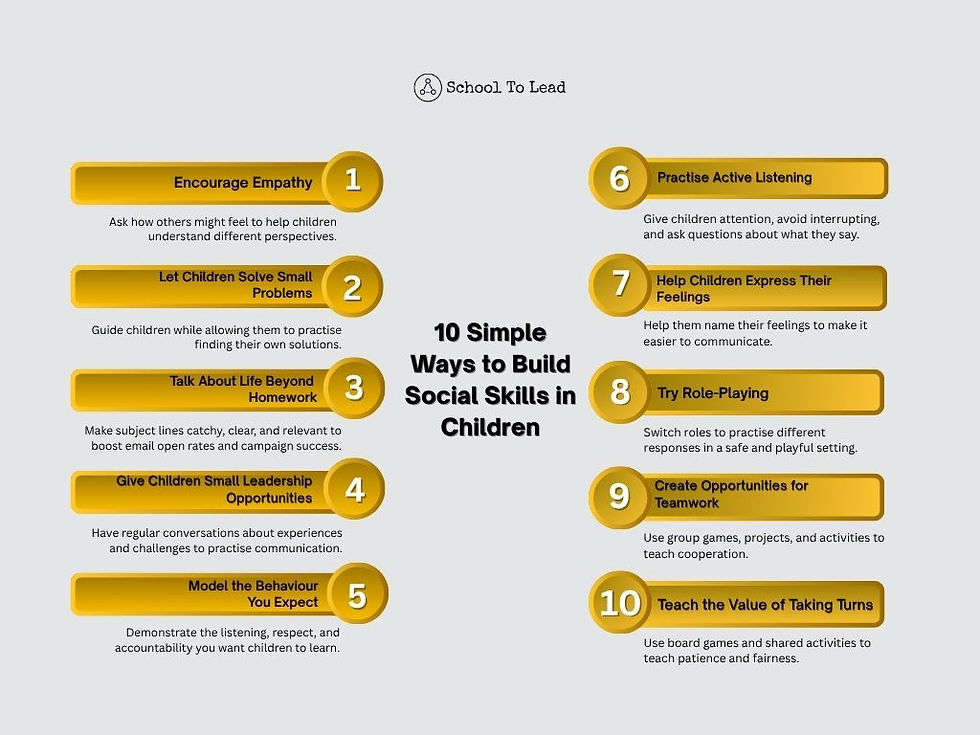
6. Encourage Empathy
Ask, “How do you think they might feel?” when discussing a story character, classmate, or friend. Such conversations encourage children to look beyond their own perspective and understand that people can experience the same situation differently.
7. Let Children Solve Small Problems
Instead of immediately solving disagreements, ask, “What could you both do?” or “What could you say to your friend?” Adults can guide children while allowing them to practise finding solutions.
8. Talk About Life Beyond Homework
Ask about friends, experiences, challenges, and things children noticed during the day. Regular conversations help them practise explaining themselves, listening, asking questions, and expressing opinions.
9. Give Children Small Leadership Opportunities
A child might organise a game, help a younger student, explain an activity, present an idea, or take responsibility for a shared task. These experiences show that leadership involves listening, responsibility, cooperation, empathy, and helping others participate.
This aligns with School To Lead Foundation's focus on Student Leadership and learner participation.
10. Model the Behaviour You Expect
Children learn by watching adults. If we want children to listen, we need to listen. If we want respectful disagreement, they need to see it. If we expect apologies, adults should acknowledge their own mistakes.
Social skills are taught through everyday behaviour as much as through direct instruction.
Parents and Teachers Have a Shared Role
Social development is not only a parent's or school's responsibility. Parents shape conversations, relationships, responsibilities, and interactions at home. Teachers create opportunities for teamwork, discussion, peer learning, and leadership at school.
When children receive consistent encouragement in both environments, social learning becomes part of everyday life. This reflects School To Lead Foundation's focus on students, educators, and parents as important parts of a stronger education ecosystem.
Social Skills Are the Building Blocks of Leadership
Leadership in childhood does not necessarily mean being the most confident or vocal person. A child who listens to others, includes a classmate, communicates an idea, accepts responsibility, or helps resolve a disagreement is practising leadership.
Social skills provide important building blocks for responsible leadership, including communication, empathy, teamwork, perspective-taking, and accountability.
School To Lead Foundation's work around Student Leadership reflects this wider view, where children are given opportunities to participate actively and grow through meaningful experiences.
Helping Every Child Grow at Their Own Pace
Some children make friends easily; others need more time. Some enjoy speaking in groups, while others prefer smaller conversations. Parents and educators can create safe opportunities to interact without constantly comparing children with others.
Small steps matter: saying hello to someone new, sharing an idea, asking for help, listening during a disagreement, or taking responsibility for a group task can all represent meaningful progress.
An education NGO in Ahmedabad can contribute to an ecosystem where children develop practical skills alongside academic knowledge. For an NGO working for education in Ahmedabad, this broader focus can be meaningful when education is viewed as preparation for participation in everyday life, not simply examinations. Those who wish to contribute may also explore ways to volunteer for an NGO in Ahmedabad, depending on an organisation's programmes and opportunities.
Give Children Opportunities to Practise
Social skills cannot be developed through instructions alone. Children need opportunities to listen, communicate, cooperate, disagree respectfully, solve problems, show empathy, and take responsibility.
A family conversation, classroom project, game with friends, or small responsibility at home can become a learning experience. When education gives children space to participate rather than simply follow instructions, they develop more than knowledge. They begin to understand themselves, work with others, and contribute to their communities.
That is an important part of helping children grow-not just into better students, but into thoughtful, capable, and responsible people.
Written by Jinesh Shah for School To Lead


Comments