
How Hands-On STEM Activities Can Transform Learning for Children
Picture a classroom where a child isn't just reading about gravity, electricity, or how plants grow - they're building, testing, watching things fail, and trying again. That shift, from reading about an idea to actually living it, is where real learning tends to stick.
For years, classrooms have leaned on memorization: read the chapter, remember the facts, answer the question correctly. It works for recall, but it rarely builds understanding that lasts. Hands-on STEM activities for children flip that model. Instead of memorizing what a pulley does, a child builds one. Instead of reading that some materials filter water better than others, they test it themselves.
At School To Lead Foundation, an education NGO in Ahmedabad working toward more holistic, learner-centred education, this is a core belief: children don't just need information - they need the chance to explore it with their own hands.
What Are Hands-On STEM Activities?
STEM brings together Science, Technology, Engineering, and Mathematics - but a "hands-on" STEM activity is more than handing a child some materials and a worksheet. It follows a natural cycle: question, explore, build, test, fail, improve, reflect.
That could look like building a simple bridge from everyday materials, designing a balloon-powered car, growing seedlings and tracking their progress, or measuring shadows to understand how sunlight changes through the day. What ties these together isn't the equipment - it's the process of figuring things out.
Why Hands-On Learning Works for Children
It turns abstract ideas into real experiences. A child can see and touch a concept instead of only reading a definition of it.
It sparks curiosity. The question shifts from "what's the right answer?" to "why did this happen?" and "what if I try it differently?"
It makes mistakes useful. A bridge that collapses or a plant that doesn't grow isn't a failure - it's the start of the next question.
It turns children into active participants, not passive listeners, in their own learning.
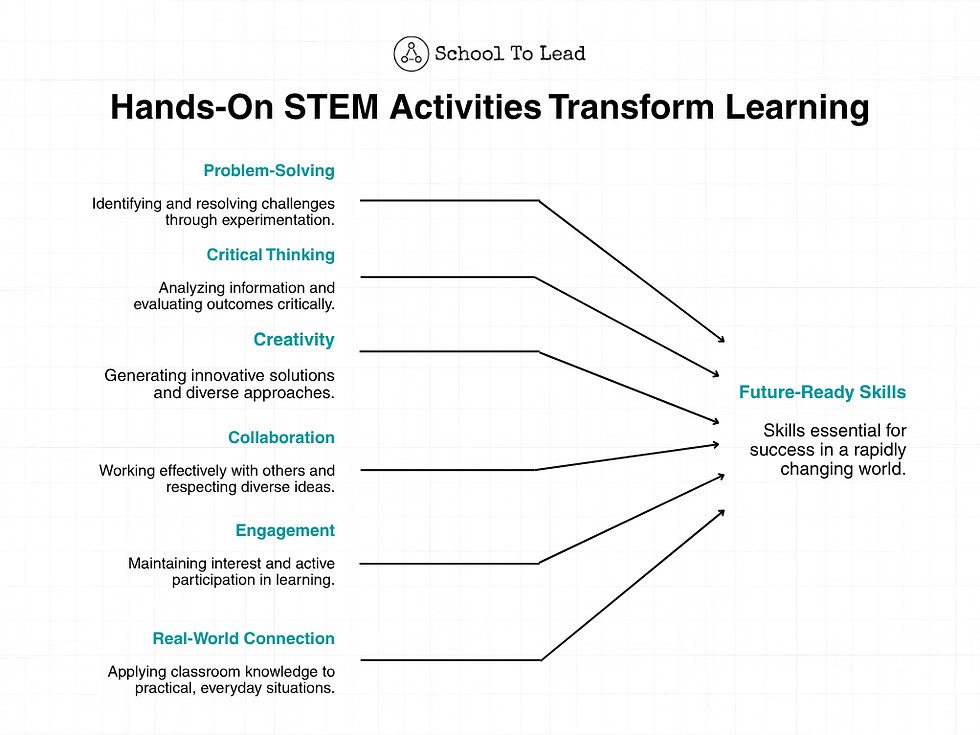
7 Ways Hands-On STEM Activities Transform Learning
Builds problem-solving skills - children learn to identify a problem, test possible solutions, and adjust based on results.
Develops critical thinking - through observing, comparing, questioning, and evaluating outcomes.
Encourages creativity - the same challenge can have many valid solutions, not just one correct formula.
Strengthens collaboration - group projects teach communication, shared responsibility, and respect for different ideas.
Makes learning more engaging - a child who drifts off during a lecture often leans in when asked to build or investigate something.
Connects classroom learning to real life - why do objects float, how much water does a container hold, how do you build something stronger?
Builds future-ready skills - adaptability, teamwork, decision-making, and curiosity that matter well beyond any STEM career.
Simple Activities Children Can Try - No Expensive Equipment Needed
The Strongest Paper Bridge - testing how paper shapes hold weight
DIY Water Filter - comparing how different materials filter water
Balloon-Powered Car - designing a vehicle powered by released air
Plant Growth Investigation - changing one variable, like light or water, and recording results
Tower Challenge - building the tallest stable structure with simple materials
Classroom Waste Challenge - measuring waste and brainstorming ways to reduce it
STEM Doesn't Have to Be Expensive
There's a common assumption that STEM education needs labs, robotics kits, or advanced computers. It doesn't. Meaningful hands-on STEM learning can begin with paper, cardboard, string, cups, bottles, rubber bands, and recycled materials. What matters most is the quality of the question and the learning process - not the price tag of the equipment. This makes hands-on STEM especially achievable for under-resourced schools.
Making STEM Learning More Inclusive
Every child should have access to these opportunities, regardless of background or learning pace. Schools can support this by using low-cost materials, rotating roles within group projects, allowing multiple paths to a solution, encouraging girls and boys equally, and focusing on curiosity and effort rather than only the final result. This is central to School To Lead Foundation's broader commitment to equitable, holistic education - working with under-resourced schools and treating learners, educators, and parents as connected parts of the same journey.
The Role of Teachers in Hands-On STEM Learning
Teachers don't need every answer ready. Their role can shift from "I will explain the concept" to "I will help you investigate the concept." That means asking open-ended questions, letting students predict outcomes, allowing productive failure, and encouraging children to explain their own thinking. This mirrors the approach behind School To Lead Foundation's Educator Project, which supports teachers with pedagogy and classroom strategies designed to make learning more interactive.
How School To Lead Foundation Supports Future-Ready Learning
School To Lead Foundation believes education should go beyond simply delivering information. As an education NGO in Ahmedabad, its approach places learners at the centre, emphasizing holistic development through academics, values, and leadership.
Hands-on STEM learning fits naturally into this philosophy - giving children real chances to ask questions, make decisions, solve problems, collaborate, and learn from mistakes. It also aligns with the Foundation's focus on Student Leadership, where learners actively participate in their own growth and support the growth of their peers.
How Schools and Parents Can Encourage STEM Learning
For schools: introduce project-based activities, create STEM corners using recycled materials, dedicate regular time to experimentation, and let students present their solutions to real community problems.
For parents: encourage kids to ask "why" and "how," try simple experiments at home, involve children in everyday measuring and problem-solving, and celebrate curiosity as much as correct answers. Small, regular hands-on STEM activities for children at home can reinforce what happens in the classroom.
From Memorizing Answers to Creating Solutions
The traditional approach follows learn, memorize, answer. The hands-on approach follows question, explore, experiment, make mistakes, improve, understand. The goal isn't to replace traditional learning - it's to complement it with experiences that help children actually apply what they know. (Read more in our related article, Why Every Child Should Learn Problem-Solving Before Memorization.)
Let Children Learn With Their Hands, Minds, and Imagination
STEM education doesn't need to start with expensive technology. It can start with a question, a piece of cardboard, a failed experiment, a curious child, and an adult willing to say, "Let's find out." When children are given room to build, test, question, and improve, they gain more than STEM knowledge - they gain the confidence to face unfamiliar problems and search for their own solutions.
Explore how School To Lead Foundation is working to make learning more holistic, engaging, and future-ready for children, educators, and communities.
Written by Jinesh Shah for School To Lead

Comments