
Why Every Child Should Learn Problem-Solving Before Memorization
Picture a Class 5 student who can recite the water cycle word for word, complete with every technical term her textbook uses. Now picture the same student standing in front of a leaking tap at home, unsure of what to do. She knows the theory. She has never been asked to apply it.
This gap between "knowing" and "doing" shapes how many children are taught today. Classrooms often reward the student who remembers the most, not necessarily the one who understands the most. Exams are built around recall, and somewhere in this system, the habit of thinking through a problem gets quietly pushed aside.
But the world children are growing into does not run on memorized answers. It runs on judgment, adaptability, and the confidence to work through the unfamiliar. This is exactly why building strong problem-solving skills for children has become one of the most important conversations in education today.
The Difference Between Memorization and Problem-Solving
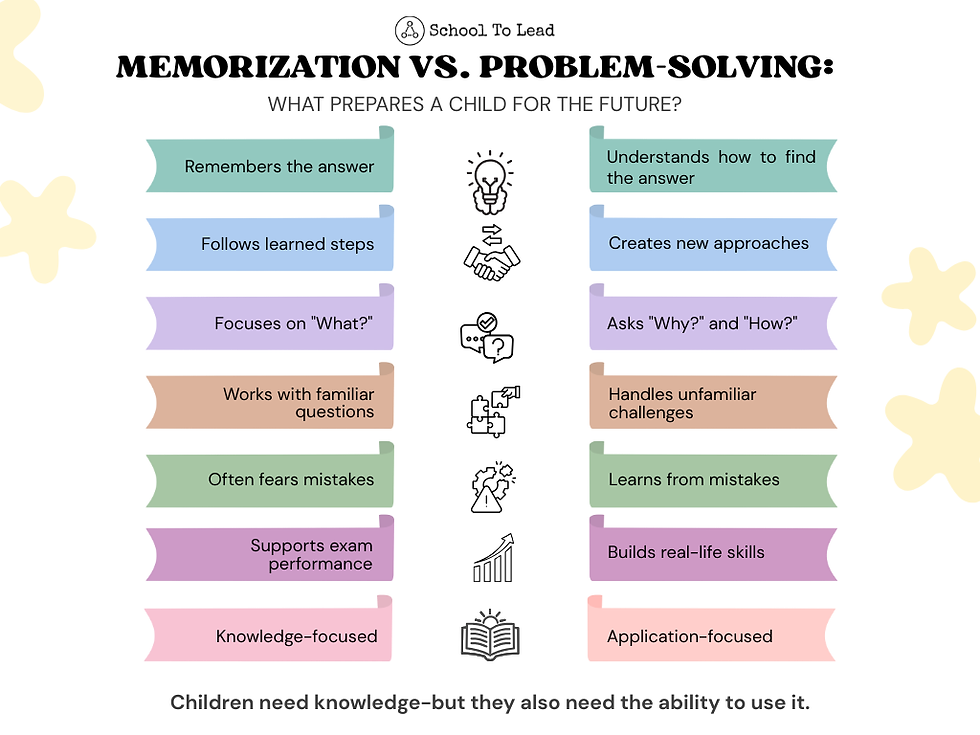
Memorization is the ability to store and recall information exactly as it was presented. It has its place; children do need to remember multiplication tables, historical dates, and scientific formulas.
Problem-solving is different. It is the ability to take what you know, apply it to a new or unexpected situation, and work toward a solution, breaking a challenge into parts, testing ideas, and adjusting course when something does not work.
A child who memorizes can answer a question exactly as it was taught. A child who has learned to problem-solve can answer a question that was never taught at all, because they understand the concept well enough to reason their way there. That difference is where real, lasting learning begins.
Why Problem-Solving Matters in Today's World
Children today face situations their textbooks never anticipated: a group project where teammates disagree, a science experiment that does not go as expected, a friendship conflict that needs a thoughtful response rather than a rehearsed one.
Strong problem-solving abilities help children in several connected ways:
Independent thinking - learning to form their own opinions instead of waiting to be told the answer
Adaptability - adjusting when a plan does not work the first time
Better decision-making - weighing options instead of guessing
Creativity and innovation - finding more than one way to reach a solution
Confidence - trusting their own ability to figure things out
Communication and collaboration - explaining their thinking and working through disagreements with others
These show up when a child negotiates turns on the playground, budgets their pocket money, or works out why their volcano model did not erupt as expected. This is where critical thinking for children stops being a classroom phrase and becomes a life skill.
The Hidden Limitations of Rote Learning
Rote learning is not the villain here, but it does have real limitations when it becomes the primary way children are taught. Information memorized without understanding tends to fade quickly, often right after the exam. Because there is only ever one "correct" answer to recall, children can grow anxious about getting things wrong, which discourages intellectual risk-taking. Creativity narrows when there is little room to explore alternatives, and curiosity fades when learning feels like storage rather than discovery. Over time, children can become dependent on being told the answer instead of trusting themselves to find one.
None of this means memorization should disappear. Facts still matter, and a strong knowledge base supports good thinking. The concern is when memorization becomes the destination, rather than a tool that supports something bigger.
How Parents and Teachers Can Build Problem-Solving Skills
The good news is that problem-solving can be nurtured in small, everyday ways. Asking open-ended questions like "What do you think would happen if…" invites a child to reason rather than recall. Encouraging curiosity, even when questions feel endless, keeps that instinct alive instead of shutting it down. Project-based learning, where children build, design, or investigate something over time, mirrors real-world problem-solving far more closely than a worksheet does. Everyday moments, like planning a family outing or figuring out a recipe substitution, are natural problem-solving opportunities hiding in plain sight. Teamwork teaches children to solve problems alongside others, and reflecting after a mistake, rather than rushing past it, helps them see errors as useful information instead of failures to hide.
Giving children real opportunities to make decisions, even small ones, builds the muscle they will need for much bigger decisions later.
How School To Lead Foundation Encourages Future-Ready Learning
This shift, from remembering to understanding, is central to the work of School To Lead Foundation. As an education ngo in Ahmedabad, School To Lead focuses on student-centered learning where children are active participants in their own growth, not passive recipients of information.
Through experiential and leadership-based approaches, School To Lead Foundation creates spaces where children practice thinking, not just recalling. Learners are encouraged to ask questions, work through challenges with peers, and take ownership of their choices, while educators and parents are brought in as partners in that process. As an education foundation in india, School To Lead treats leadership, confidence, and critical thinking as just as essential to a child's education as academic knowledge. This is what it means to work as an ngo working for education in india: building systems where children are trusted to think for themselves.
Preparing Children for a Future That Doesn't Yet Exist
Many of today's students will grow up to work in roles that do not exist yet, alongside artificial intelligence and automation reshaping entire industries. Careers will shift more often than they did for previous generations, and the specific facts a child memorizes today may well be outdated by the time they enter the workforce.
What will not become outdated is the ability to think clearly, adapt to new situations, and keep learning throughout life. This is why raising future-ready learners means prioritizing skills that transfer across every subject and stage of life, regardless of how technology evolves.
Conclusion
Memorization can help a child pass a test. Problem-solving helps a child navigate life. Both have a place in education, but only one prepares a child for everything they have not yet encountered.
Choosing to value understanding over recall is one of the most meaningful shifts parents, teachers, and school leaders can make in how they raise the next generation. Every child deserves an education that teaches them how to think, not just what to remember.
If this vision resonates with you, School To Lead Foundation welcomes parents, educators, and changemakers to learn more about its work in building future-ready learners across India.
Written by Jinesh Shah for School To Lead

Comments