
Growing Up Well: How Home, School and Society Shape Children's Mental Health
Introduction - A Child's Mental Health Is Shaped Everywhere
Picture a ten-year-old who comes home every day with a bright smile and good grades. On paper, everything looks fine. But underneath, she might be quietly anxious about disappointing her parents, unsure where she fits in among classmates, or tired from trying to keep up appearances. Many children carry these invisible pressures without anyone noticing, simply because they look "fine" on the surface.
This is one of the most important things to understand about children's mental health: it is rarely shaped by one place or one person. It develops gradually, through everyday experiences at home, in the classroom, with friends, and within the wider community a child grows up in.
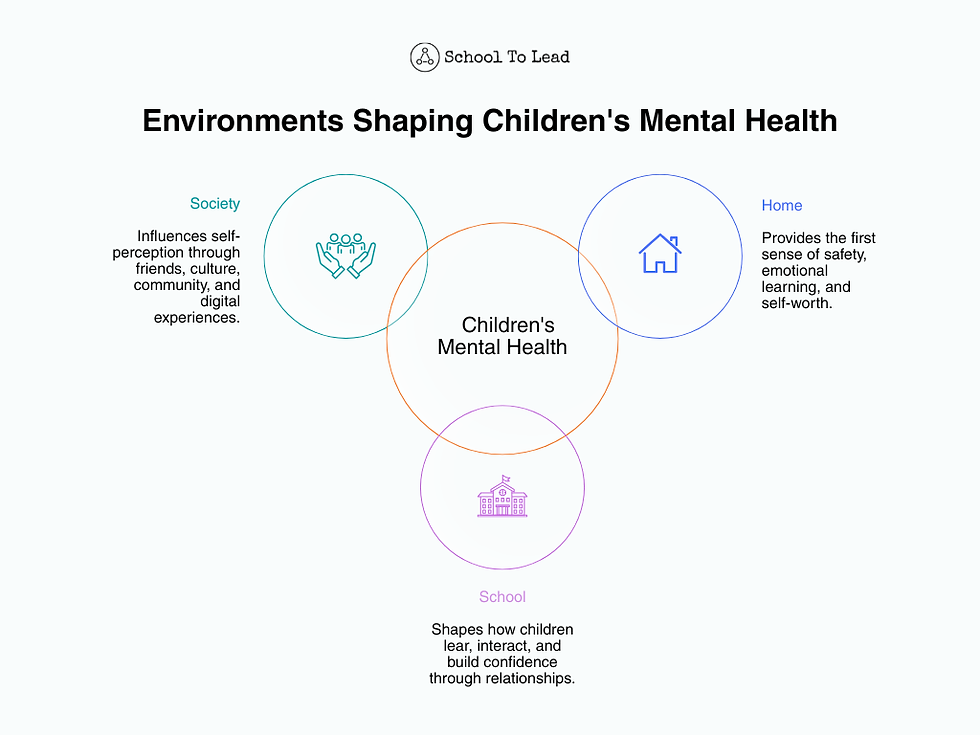
Home gives children their first sense of safety. School shapes how they learn and interact. Society - friends, culture, community attitudes, even the digital world - influences how they see themselves and their place among others. Understanding child mental health means looking at all three of these environments together, not just one.
Why Children's Mental Health Matters
Mental health in children is not separate from learning or growing up - it's woven into it. A child's emotional state affects how well they concentrate, how easily they make friends, and how they respond when things don't go their way.
Healthy emotional well-being of children shows up as confidence and self-esteem, the ability to communicate and form relationships, resilience during setbacks, growing independence, and a genuine sense of belonging. When children struggle emotionally, it often shows in ordinary ways - reluctance to go to school, trouble concentrating, or sudden changes in behaviour. This isn't about diagnosing a child; it's about recognising that children's emotional well-being deserves the same everyday attention as their physical health.
How Home Shapes Children's Mental Health
Home is usually where a child first learns about emotions, relationships, and self-worth.
Emotional safety starts here. Children feel safe when they can express difficult feelings without being immediately judged. Listening before reacting, keeping routines predictable, and making children feel valued beyond their grades all build this foundation.
The way adults respond matters. Children watch closely. How parents handle stress, failure, or disappointment quietly teaches children how to handle the same things themselves.
Communication matters more than perfection. Regular, unhurried conversations do more for a child than any single "big talk." Asking how they really feel, avoiding comparisons with siblings or classmates, and offering age-appropriate choices all strengthen mental health at home. This is also where the role of parents in child development becomes central - not as passive supporters, but as active partners in a child's emotional growth.
How Schools Influence Children's Mental Health
Children spend a large part of their day at school, so its culture and relationships shape far more than academics.
The teacher-student relationship can make a child feel heard, respected, and safe enough to ask questions or admit confusion. The role of teachers in children's mental health is often underestimated, yet it shapes how comfortable a child feels in any learning environment.
Academic pressure and fear of failure - exams, comparison, and constant focus on marks - can weigh heavily on children. High expectations and emotional support are not opposites; a classroom can hold both.
Emotionally supportive classrooms are built through everyday habits: normalising mistakes, recognising effort over outcomes, encouraging teamwork, and giving students a genuine voice in decisions. This mirrors School To Lead Foundation's focus on student leadership - the idea that children given real responsibility develop stronger confidence and a healthier relationship with learning.
How Society Shapes Children's Mental Health
Beyond home and school, children grow up inside a much wider social world.
Friends, peers, and the need to belong shape how children see themselves. Exclusion, comparison, or bullying can affect confidence long after a single incident is forgotten. Belonging is often central to emotional security.
Social media and digital culture bring new pressures - comparison, curated lives online, and occasionally cyberbullying - but technology isn't inherently harmful. What matters most is guidance: healthy boundaries and digital awareness, not fear.
Community, culture, and social expectations - around success, gender, or economic circumstance - quietly shape how children see their own worth. Children do not grow up in isolation. The attitudes around them often become part of how they understand themselves.
What Happens When Home, School and Society Work Together?
A simple way to think about it: Home → School → Community. Home provides emotional security. School provides structure and confidence-building relationships. Community provides belonging and role models. When all three send the same message - your feelings matter, mistakes are part of learning, you belong here - children get a stable, reinforced foundation for mental health and child development. When the messages conflict, children are left to make sense of the gap alone.
What Adults Can Do to Support Children's Mental Health
For parents: Listen before advising. Make time for real conversations. Avoid comparisons. Take behaviour changes seriously. Celebrate effort, not just achievement.
For teachers: Build trusting relationships. Notice changes early. Create inclusive classrooms. Reduce fear around mistakes. Make emotional well-being part of everyday classroom culture.
For communities: Create inclusive, safe spaces for children. Challenge harmful stereotypes. Encourage open conversations about emotions and closer collaboration between families and schools.
How School To Lead Foundation Supports Holistic Child Development
School To Lead Foundation believes education should develop the whole child, not just academic performance. As an education ngo in Ahmedabad, it works closely with learners, educators, and parents.
The Educator Project supports teachers' professional growth and well-being, recognising that a teacher's own emotional state shapes the classroom. The Parent Project helps parents build more supportive home environments for children's emotional and personal growth. Its work on student leadership gives children real opportunities to participate and support peers, building confidence and empathy. And The Bridge Project brings together students from different socio-economic backgrounds, encouraging empathy, gratitude, and humility.
As an ngo working for education in India, School To Lead Foundation isn't a clinical mental-health provider - it works toward holistic education, recognising that supporting children's confidence and belonging is inseparable from supporting their learning.
Growing Up Well Is a Shared Responsibility
Parents cannot do it alone. Teachers cannot do it alone. Neither can schools or communities acting in isolation. Children's mental health develops through the combined, everyday influence of relationships, environments, and opportunities - at home, in classrooms, among friends, and across society.
When adults across these environments help children feel safe, heard, respected, and included, they are doing more than supporting mental health - they are helping children grow into confident, resilient, and empathetic individuals. Organisations like School To Lead Foundation are one part of this larger, shared effort - working alongside parents and teachers to help children not just perform well, but grow up well.
Written by Jinesh Shah for School To Lead


Comments